Thursday, February 16, 2012

Learning From Online Reviews

I attneded a presentation by author J. Scott Savage titled, Using Reviews to Improve Your Writing. It was awesome. He presented a method for doing market research for potential novel ideas that you have.

Go to goodreads.com or amazon.com, and find five books that are similar to the kind of book you’re writing. Read through as many of the reviews as you can. Here is what you’re looking for:

One-star reviews
These reviews were from people that were not the target audience. Jeff recommended that you print them out and tape them to your wall. Then when you’re feeling down you can read them and tell yourself “That book was a best-seller, and someone still hated it.” Everyone looks for something different in a book. If you haven’t disgusted a few readers then your work probably isn’t very original.

Two-star reviews.
This happens when a book didn’t quite live up to the expectations of the reader. Take a hard look and ask yourself if anything in this review applies to your own work. Ask yourself if there isn’t something you can do better, some new twist you can try.

Three-star reviews.
These reviews tend to be the most useful, because they come squarely from the target audience (especially true if the book is the first in a series). Pay attention to what these readers liked. Pay attention to what they didn’t like. Look for trends, and make sure you don’t follow the same mistakes that the author made. Emphasize in your work the things that these readers praised.

Four-star reviews
For most people this means that they liked the book a lot. You’ll get good info here, too.

Five-star reviews
Mom, is that you?

The series effect


Here is another exercise you can do to understand what your readers are looking for. To illustrate, go to Amazon and take a look at the Recluse series, by author L. E. Modesitt Jr. Here is an analysis of the first five books in the series (there are currently 16).


  1. The Magic of Recluse: 131 reviews, 3.5 stars. Very few people are in the middle. Most reviewers either liked it or hated it.

  2. The Towers of the Sunset: 49 reviews, 3.5 stars. The trend is sort of flat, with an even distribution of likes and dislikes.

  3. The Magic Engineer: 40 reviews, 3.5 stars. By this time the positive reviews are definitely more numerous than the negative reviews.

  4. The Order War: 18 reviews, 3.5 stars. Trend is similar to book 3. People are beginning to comment how the writing has improved.

  5. The Death of Chaos: 20 reviews, 4 stars. The trend is definitely positive. Very few negative reviews.


Did you notice that each successive book gets fewer and fewer reviews?

The first book in a series is always going to have lower reviews because it’s the one that everyone reads. The author is going to get a mix of people who liked it and people who detested it. Those who didn’t like book 1 will not buy book 2, so when book 2 comes out there will be fewer reviews but more of them will be positive. This trend will continue as the series progresses until book 5 when you see only a handful of reviewers, and they are overwhelmingly positive.

In short, only fans review the later books in a series. By this time the author has established themselves with their target audience. Pay close attention to what the reviewers praise. There will still be bad reviews. These are from fans who got let down. What didn’t they like?

As you write your own stories, keep in mind that book 1 is your most important work. This is the vehicle for introducing your writing to new readers. It will always sell the most copies. Some people will love it and some will despise it. Don't try to please everyone. Know your target audience, and write specifically for them. Your later books will always get better reviews.

Wednesday, February 15, 2012

eBooks-A Good Way to Get Published?

I got a huge, huge pick-up from this year’s Life, the Universe, and Everything symposium. There’s always a class or two that I find worth it to go and see. This year was like a second Christmas. I focused mostly on the classes about ePublishing, and self-promotion.

This was by far the most sanguine panel I went to. At the start of this panel I was about 60% sold on the idea of ePublishing. By the end of this panel I was 90% sold. The important thing to remember is that there isn’t just one thing that brings in sales. It’s a combination of many things. One of the panelists used this analogy of using a hammer to pound invisible nails. You don’t know where to hit, and the best thing to do is start swinging.

Here is a short list of things that you should try. Each one of these is a discussion in and of itself, so if you want more information, copy and paste the item into Google:


  1. Amazon KDP Select.

  2. Smashwords.

  3. Blog Reviews

  4. Book Bombs

  5. Try to get at least three reviews on Amazon

  6. Book Trailers


Above all, make sure you keep writing. You have to learn to split your time evenly between writing and promoting. What is a good percentage? There isn’t one. Set goals. Make a resolution to produce one new novel as often as you feel comfortable, and to keep an active presence in the Internet. The important thing is consistency.
Some things to beware of:


  1. Don’t ePublish until you have at least three books to put up. Why? Because having more stuff gives the impression of credibility. Content is king, and it gives people a reason to come back to your website again and again.

  2. Space your releases about three to four months apart. If you have more books, put a “coming soon” notice so that your readers will be reminded to check back.

  3. Don’t let people hijack your schedule. It’s easy to get stuck waiting for artists, beta-readers, and others hold you back. If you know your work is ready to go, then go. The nice thing about ePublishing is that you can change things if you need to.


Conclusion:
I’ve been skeptical about ePublishing, but now I’m completely sold for three very important reasons:

  1. Amazon and Smashwords are the new slush pile. Publishers are not the least bit picky about picking up a self-published author who has a proven track record for success. The only people who look down on ePublishing are other authors.

  2. The skills required for promoting your work are identical whether you are self-published or commercially published. It’s a huge win with publishers if you have an established following.

  3. It’s just so easy. The tools are all there, and there is no risk to you. If you stick with it until you’ve obtained a measure of success, it will eventually lead to a publishing contract.


P.S. You can follow me on Twitter. My username is @TWAbbottJr. If you have a blog and something you want to say, this is a great way to get out the word. Follow me and I'll follow you.

Friday, May 20, 2011

Getting Rid of Unwanted Calls, Once and for All

If you’re like me, the first thing you did when you signed up with the phone company was to head over to www.DoNotCall.gov, and entered your phone number into the national don’t-bother-me registry.

That will take care of most telemarkerters, except:
1. Charities, of which there seem to be no end.
2. Businesses with whom you are already a client.
3. Political calls.
4. Telemarketers who simply ignore the list.

So it’s sort of addressed the problem, but you still get unwanted calls.

One solution is to get a call zapper. This is a little black box you insert into your phone line. It’s supposed to send some kind of operator-signal when a telemarketer calls that will make the telemarketer think that your phone number is disconnected.

Cool, eh? Well if you have an answering machine or voicemail service, I can tell you how to do the same thing—absolutely free.


Special Information Tones


Have you ever dialed a number that was disconnected and heard three beeps, the first one low, the next one high, and the last one higher? That’s called a Special Information Tone (SIT). SIT tones were created because automated dialing equipment like modems, and network call detector/classifiers simply cannot decipher between a live answer or a recording, or what is said in a recorded announcement.

There are eight SIT tones in all. It turns out that one of them means “Number changed or disconnected.”

So how do you use this? Simple, really. You make an answering machine message that has this particular SIT tone at the beginning, then record your regular message.

When you get a call, you check your caller ID. If it says “private name, private number”, then you let your answering machine get it. The answering machine plays “beep beeeep BEEEP I’m sorry, I’m not available to take your call right now. Please leave a message after the tone.”

With me so far?

Let me tell you, this works. Right after I set up my answering machine I got an automated call from the Salt Lake County library that one of the books I had on hold was available. The computer never left a message—it just hung up. When I went to pick up my book, the system told me that the number it had on file was invalid and I needed to file a new number. (It still let me check out my book, though).

Sweet.

Since then I’ve gotten several political calls and charities. I just let the answering machine get it.


Setting it all up.


So, you can get ahold of a recording of a SIT tone. Go to Wikipedia and look up “Special information tones”. That will take you to the page you want. Next, scroll down to the list of example SIT recordings. The one you want is called “Intercept”, about half-way down the list. If you press the play button you can hear it.

Download the file and save it on your computer.

Next, you’ll need a sound editor. There are a number of good ones on the web. The one I like best is called GoldWave. You'll ned one that will allow you to splice two sounds together. It should also be able to play .ogg files.

Load up the SIT tone in your sound editor. Make a second recording of whatever greeting message you want. “You have reached the Abbott residence, but we are unable to get to the phone right now. Please leave your name and number after the meeep.”

When you splice the two sounds together, you’ll want about a half-second gap of silence, so people can hear your recording better. You’ll also want to adjust the volume of your recording so it is about as loud as the SIT tones.

You do not want to have the SIT tones loud and have your voice soft, or your friends will think your phone got disconnected! Play with the volume on your voice recording until it is about as loud as the SIT recording.

When you’re ready, you’ll have to move your answering machine close to your computer speaker—I mean really close, or the recording won’t be loud enough. You’ll want to play back the recording from your answering machine until it sounds loud enough that you can hear it completely.

That’s really all there is to it.


Downsides


You might want to warn your friends and family, just to be on the safe side. When people call you and the answering machine gets it, there will be a moment of confusion when they hear the error tones.

You might miss important messages that way, like when the library calls you about that overdue book, or the bank wanting to tell you that someone has swiped your credit card number and wants to buy a new 60” TV.

There are no perfect solutions to the telemarketer conundrum. This technique works, but there are downsides. Use this knowledge at your own discretion.

Friday, September 24, 2010

Spain, Cartagena

This is the second part of a two part post.  You can read the first part here:

Friday, September 17, 2010
Madrid: Plaza Mayor, and Placio Real
Today’s adventure started with an excursion through the streets of Madrid. The first place we saw was El Plaza Mayor. My feet were killing me and we were pushed for time, so I didn’t take any pictures. We met a nice young Italian couple, who couldn’t speak anything but Italian. They wanted me to take their picture.

What we really wanted to see was El Placio Real, the royal palace, and that did not disappoint. There was a lot of stuff we weren’t allowed to take pictures of, and it would be hard to put it all into words. In short, it was opulent. The king of Spain doesn’t stay there; instead it is used for state occasions such as the signing of treaties, etc.

The best part of the Palacio Real for me was the armory, which had swords and suits of armor. People think of the era of knighthood and tournaments and jousting as iconic of the middle ages, but that all happened toward the latter end. Most of the stuff we saw was never used in war. We did see a breastplate that was riddled with dents from musket balls. That was at the very end of the exhibit, 1600s.

Madrid: Mission Reunion.
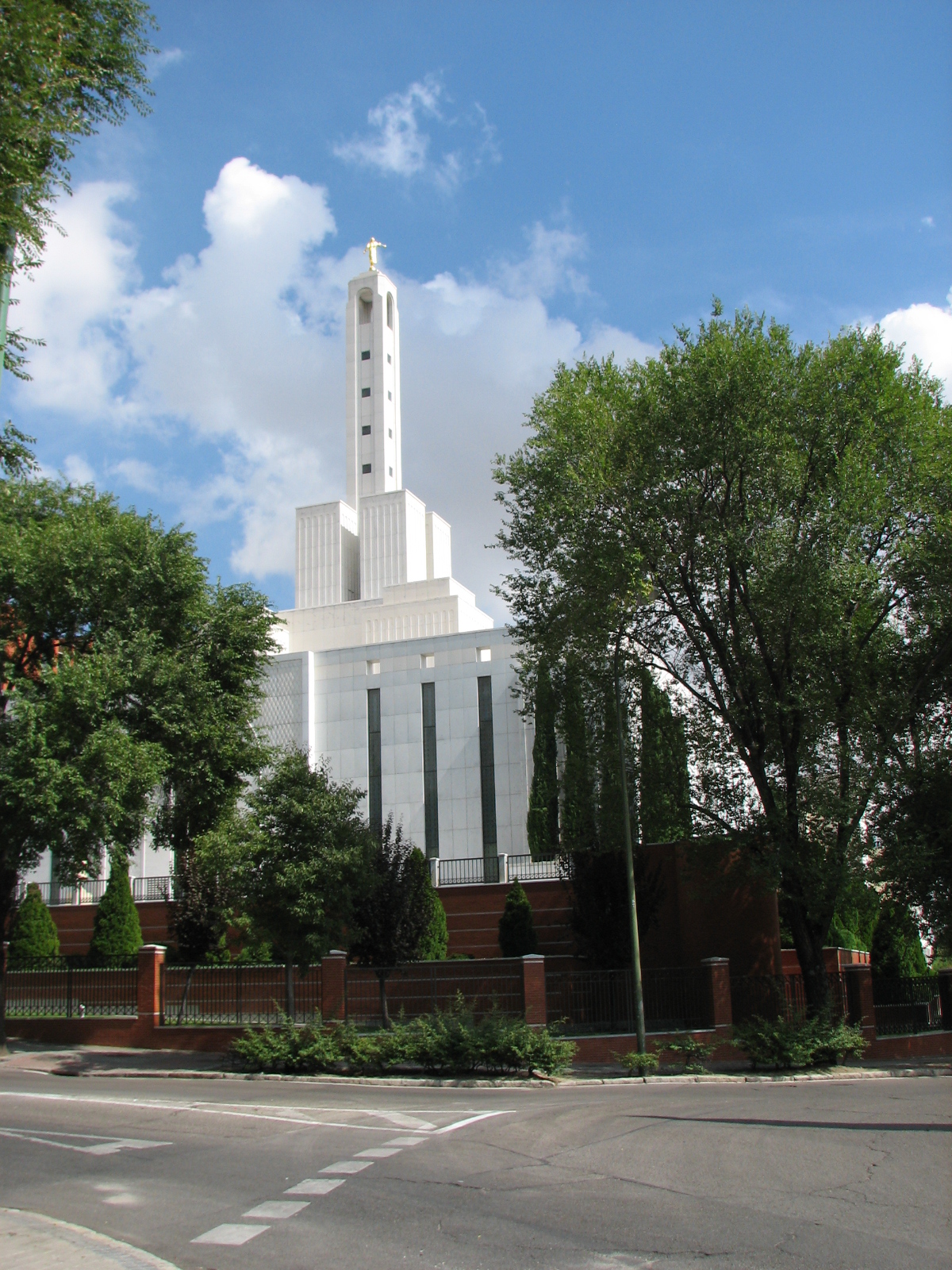
We met at the LDS temple. I got one picture of the outside of the temple, then my batteries went kaput. I’ll have to have others send me copies of all the group photos we took.


Anna and I got a ride back with a former companion and friend of mine, named Eduardo Saavedra. He and his wife gave us a whirlwind street tour of Madrid. We saw a bunch of places that were very pretty but I don’t remember the names of. It was nice to see the city above ground for a change. The metro is wonderful for getting you from A to B, but you don’t get to see anything but the inside of your train car.

Saturday, September 18, 2010
Madrid: Parque de Refugio
We were spent from all the running around. Wanted to go see Avila, because it was another walled medieval town like Segovia and Toledo, but we woke up way too late. Instead we went to Corte Ingles, then we went strolling through the Parque de Refugio (Park of Refuge). It was crowded with people going on paseo, and eclectic street performers.

We finished the evening with gofres (waffles) topped with Haagen-Dazs, and took another stroll through La Puerta del Sol and watched more performers. A human statue made himself look like a street cleaner. Put money in his cup and he springs to life for a moment, sweeping with his push broom, then goes still. It is utterly convincing. Guys on rollerblades did stunts. The crowd around them was thin and unimpressed. Another man sat beneath a covered table, his face and hair made up to look like an African native, and his head poking up through a hole so he looked like a severed head on a plate. “Guapa!” he called to the women. “Dame un beso!” and made kissing noises. His hands controlled two other head puppets. It gave everyone the creeps, but he always had a crowd.

Sunday, September 19, 2010
The Train to Cartagena
You don’t think of Spain as desert, but it is. The soil becomes more sandy, and dried grass grows more sparse between clumps the farther south you go. Occasional Acacias and prickly pears spring up in thorny patches. Palm trees sway in the heat.

We pass through rough country. Distant mountains jut toward the sky, their sides treacherous and rocky. Hills and crags are made of whitish chalky rock, or layered sandstone. The trees are all stunted pines and cypresses. No sage. It looks a lot like eastern Oregon, but missing are the dark-layered lava flows, and columns of basalt formations you might expect to see. This area is not volcanic.

Groves blanket the hills, mile after mile. It looks like Yakima Valley, but with Spanish architecture. You get the impression that Spain grows all of Europe’s fruit, or at least a good deal of it. Orange groves. Olive groves. Almond groves. Peach groves. Vineyards, with their climbing branches spread between poles. We see no herds of animals, no fields of corn or wheat.

And then there's a castle, right in the middle of nowhere.  This one is Chinchilla de Montearagón:


We pass through clumps of civilization. The houses huddle together, sharing the same walls in the back and on each side. There are no sidewalks and no yards. Doors open onto the street. There is absolutely no urban sprawl. Civilization begins and ends at an abrupt edge, with few (if any) outlying buildings. Free-standing structures are rare. Few people have a car, so they go on foot everywhere.

Houses are always made of brick or cement, with sagging roofs of tile or corrugated galvanized steel. Many have a flat roof that can be used as a terrace. Some houses are painted, or once were long ago. Others are covered with crumbling stucco, the red brick showing beneath. Others are bare brick, or grey cement, or cinder block. Everything has a run-down half-built look to it. Some buildings look new, but quite a few are old, or abandoned and falling apart. American-style gang graffiti is everywhere.

A few years ago Spain had a real-estate boom, just like in the US. Banks gave out loans to people who couldn’t pay, thinking that with the way prices kept rising no one could lose. Now there is a lot of unfinished construction. The buildings stand naked like hulking skeletons. Silent cranes loom motionless in their midst.
Cartegena
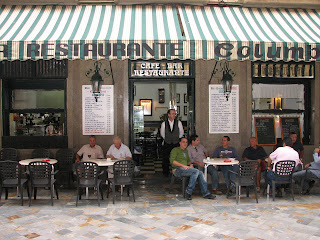
We spent the last three nights with Carmen and Jose, friends of Anna’s family. Carmen took us around to see the city. She knows everyone in her little neighborhood. She waves to friends and stops to talk. They kiss each other on the cheek. “Hola, guapa.” It impresses me how social the people of Spain are.


Two and three-story townhouses crowd the streets, built one right against the other. There’s a walled-off space between Carmen’s house and the next door down. Jose tells me it’s for one of his sons when he grows up and marries. “Family roots are very important here,” he explains. The area where they live is the closest thing to a suburb you’ll see anywhere in Spain. It’s has a small town feel in spite of it being a neighborhood in a city of 200,000.


Carmen and Jose have relatives going all the way back to the Visigoths, Moors, and probably even the Romans. Her family is somewhat influential. They have streets named after her relatives. Her father owns a large field only blocks away, surrounded by city buildings. Today it is the site of an enormous fair, with rides and booths. Carmen tells us that she has free tickets if we are interested, but we’re too beat for that kind of excitement.

We have tapas in the evening. I can’t name anything we ate. Some of it was very good. The worst was the salted, cured tuna. Very sharp! Carmen tells me that Spaniards won’t remember places they’ve been, but they’ll always remember the food.

Cartagena is in the middle of a ten-day celebration of the Roman’s victory over the Phoenicians. There are men and women everywhere dressed up in Roman and Carthaginian dress, historical re-enactors who perform mock-battles and plays of important historical events during that period. Everyone thinks it’s a strange thing to celebrate getting conquered, but they all get into the spirit. We find a stand selling churros and have something sweet after our dinner. The fair is packed with people.

Monday, September 20, 2010
Mar Menor
It is rainy and humid. My shirt sticks to my back, and even dry paper has a damp feel to it. Carmen takes us to see her family’s summer beach houses. “Down below us is the house of my aunt. Over there is the house of my brother.” She points to the balcony next door. The view is stunning, in spite of the overcast weather. Their property sits right on the waterfront, overlooking a vast lagoon with sweeping manicured beaches. A long sandbar lies across the horizon leaving only a small opening to the sea, its towering resort hotels like irregular teeth against the sky. The water is very shallow and extremely calm. The people call it “El Mar Menor,” because it is like a tiny version of the Mediterranean. The place has a very affluent feel. “In the summer, when you send your kids to live with us they can go swimming,” Carmen says.

Cabo de los Palos
A lighthouse sits on a high rock, jutting into the Mediterranean. It is raining just a bit. I smell the sea and breathe deep. Carmen likes the ocean. “It makes you feel very small.” She takes a couple pictures of me and Anna in front of the lighthouse.

Cenar (Supper)
We’re having empanadas, meat pies with a croissant crust. Some are very good. Others have a strong flavor. We try each one. Carmen won’t tell us what they are until we’ve taken a bite. I try one, it’s a little strange but not too bad. “That’s morcilla,” Jose informs me. Blood sausage.  I suddenly like it a whole lot less. I keep my mouth shut until Anna finishes hers. “You don’t have to eat it all,” Carmen says. I’m not a huge fan of anything made with blood.

Tuesday, September 21, 2010
The room we stay in has air-conditioning, the only one in the house. We keep it on constantly, but it never feels cold enough. I keep a 16oz bottle of water in my backpack, and it seems like I’m always filling it up.

The Mercado
There’s a huge market close to the port. Fishermen in the town bring in their catch early in the morning. The people eat anything that swims, and a good many things that don’t. The fish stare back with dead eyes. “If the eyes are clear then you know it’s still fresh,” Carmen explains. “That’s why they keep the head on. When you buy, they cut it and clean it for you.” She knows half the merchants by name, and moves among the booths like a veteran. The market smells fishy, but it doesn’t stink.

Boat Tour of la Puerta
Cartagena has been an extremely important Mediterranean port since it was discovered by Hannibal. It is one of the few deep-water ports in Europe, and the ship-yards there export new ocean-going vessles all over the world. Two small submarines lie in the water, sleek and black. They’re bound for South Korea. An enormous three-story yacht sits in the dry-dock. A massive oil rig from Italy awaits retrofitting before heading to the Gulf of Mexico.


When the Romans conquered Carthage they fortified the five hills surrounding the inlet, and called it Little Rome. The hills are ringed with layers of defensive walls, and each one is crowned with an artillery fortification. The mountains are honeycombed with bunkers and tunnels. There is a large naval facility.

Amphitheater
The Romans built a huge amphitheater. It fell into disuse when the Byzantines conquered the area, and was burnt down by the Visigoths. The Moors pilfered stones for other buildings, and the people built houses on top of the rubble. Over time the amphitheater was forgotten. It was discovered in the 80s and dug up again in the 90s. It is a stunning find. Anna and I spent more than an hour there.

There is an old cathedral built on top of the amphitheater, which was destroyed by Franco during the Spanish Revolution.


Necropolis
In the middle of Cartagena lies a necropolis museum. It has a fascinating collection of Iberian Celtic, Phoenician, Greek, Roman, Gothic, Byzantine, and Moorish, artifacts. We spent another hour there.

Wednesday, September 22, 2010
Museum of Underwater Archeology
This museum was dedicated to researching shipwrecks and cities that were sunken underwater. I learned that amphorae have a pointy spike on the bottom because early merchants unloaded their cargo on the sandy shore. If your jug has a pointed base instead of a flat base you can wedge it into the sand and it will stay up better.

Train to Madrid
At 4:00pm we began the first leg of our complicated homeward journey. My train ticket had the same seat assignment as another passenger, so I had to sit somewhere else. This caused a commotion at every stop we made until the car was full. The last guy to come aboard was really ticked, and we had to get the conductor before he gave up and went grumbling off to the other end of the car. Thankfully no one else got on until we got to Madrid.

I slept and read. Anna watched a movie. The landscape was interesting on the first trip, but there is nothing new to see. The ride is long and boring.

Thursday, September 23, 2010
Homeward Bound
After a near disastrous wrong stop in the metro, we make it to the airport with no time to spare. They re-open the ticketing gate with no small amount of grumbling. Another woman had a flight that left in thirty minutes, but they wouldn’t let her on. After all the frowns and pointed comments, we make it to the gate and stand around for forty-five minutes before we begin boarding, wondering what all the commotion was about.

Anna and I pass the 8-hour flight watching Fullmetal Alchemist Brotherhood until the batteries on the netbook give out. That little computer saved our sanity. We have a layover in Atlanta, and I manage to charge it enough for another hour’s respite on the flight to Salt Lake City.

Finally home, and we’re ready to have our normal lives back. The kids are super happy to see us. The house smells unfamiliar, like we’re visiting a stranger. We dole out the presents that everyone got. My internal clock tells me that it’s 5:00am, and my brain is screaming for sleep. Grandma can put the kids to bed just one more night.

Things I’ll always remember from Spain
1. Spanish tortilla. I make this all the time for my family, but somehow the way they do it in Spain tastes better.
2. The bread with the hard crunchy crust on the outside and soft tender part inside. It leaves crumbs everywhere. You can NOT buy this anywhere in the US.
3. Carmen and her husband, Jose, who labored like campeones to make sure we had tried just about every piece of Spanish cuisine there was. Thank you guys, very much!
4. Lentejas with chorizo, which I had only once during our visit. I never knew how much I missed it. I ate a lot of that in the Canaries.
5. Will Beus, a friend from my mission and my years at BYU. We hadn’t seen each other in fifteen years. He’s living in Barcelona now with his family.
6. Eduardo Saavedra. We were only companions one month, and he was one of two native-speaking companions I ever had. Thanks for giving us a lift back to the hotel!
7. Segovia, with its graceful Roman arches and magnificent castle. Anna was least excited to go there, but found it by far the most impressive place we visited.
8. Toledo, where I ran $1000 over our savings to buy souvenirs. I’m still trying to figure out how we’re gong to pay for all that stuff. I hope Anna’s dad likes the sword we got him.
9. The metro and the trains that took us literally everywhere.
10. Puerta del Sol, with its vibrant crowds, and eclectic artists and performers.

It feels like I’ve been on vacation for a long time. My first night back I dream about trains. I wake up to use the bathroom and panic because I can’t remember what hotel room we’re in. It takes half a minute for the logical half of my brain to reboot and realize that we’re not in Spain anymore. “See? There’s carpet on the floor. You never saw that anywhere, did you?” Our trip is finally at an end.

Thursday, September 16, 2010

Spain, Segovia and Toledo

Our first day in Spain was quite an adventure. I am feeling pretty jet-lagged right now. We didn’t sleep much the night before leaving, because we wanted to switch our biological clocks to Spanish time—but we ended up being too wired to sleep on the plane. Then we went straight to Segovia and spent the whole day there. In all, I think I got eight hours of sleep over a 36-hour period. Last night I crashed for about ten hours and didn’t wake up this morning until 9:50.

Segovia.
We spent our first day in Segovia. That’s the place with the huge Roman aqueduct, and the huge Disney-style castle. To say the town was picturesque really doesn’t do it justice. The place was simply extraordinary. The old part of the city is on the top of a very tall hill with steep rocky sides. The whole thing is surrounded by walls, originally built by the Romans.


The old Roman aqueduct dominates the skyline, and it cuts the town in half. You can’t tell from the post cards, but it’s right in the middle of the city. There’s a huge traffic circle on one side with a bus stop, and there’s a busy plaza on the other side, and all around are modern European style buildings. Anna was very, very impressed.

We also went to Segovia to see its iconic Alcazar. That’s the Spanish word for fortress. The castle looks like something straight out of Disneyland—but real. If you want to see an honest to goodness, fairy-tale, medieval-style castle where kings and queens actually slept, then the Alcazar de Segovia a definite must.

Toledo.
We went to Toledo to see a real medieval village. Like Segovia, Toledo also sits on top of a hill, surrounded by battlements and towers. You want to see what a fortified town from the middle-ages looks like? It has walls that are 30 to 80 feet high. It’s indescribable, and yes, people still live there—an honest to goodness city surrounded by fortress walls. How cool is that??? You just don’t see anything like that in the US.

We really should have planned that trip better. Unlike Segovia, everything in Toledo starts closing at 6:00. I was really disappointed we didn’t get to go see the cathedral. It’s supposed to be the oldest in Spain. We also wanted to see the monastery of San Juan de los Reyes.

Toledo has some incredible, incredible hand-made art. There are painted plates, which are exquisite. You can’t get them anywhere else in the world. There is this type of etched jewelry with gold and silver inlay, which is indescribable and beautiful. Then there are the swords. Toledo was once famous for its steel, and the Toledo swordsmiths were once the finest in Europe and the middle east. Most of today’s swords are replicas, somewhat cheap and touristy. You have to hunt, but if you’re persistent you can find some real quality blades.

I ended up getting a replica El Cid sword for my father-in-law. I also got a high-quality hand-and-a-half longsword made of beautiful Damascus steel. Anna got a bell, and for her mother (who has temporary command of our platoon while we’re away) we got a special surprise.


The architecture in both Toledo and Segovia is incredible. The Spaniards kicked out the Moors, but their artistic influence stayed. The train station looks like a Mosque.

Metro (Subway).
Anna and I have been discovering first-hand just how convenient a modern mass-transit system can be. Directly from the airport, we went all the way to Segovia, and set foot outside only once and that was when we got on the Ave (Spanish high-speed train). And we had a covered walkway just in case it happened to be raining.

The subway system in Madrid is extensive. It looks just like subway systems you see in movies that are set in Europe. It’s pretty noisy. It rolls and jounces along, screeching as it comes to a halt. It’s not too loud, except for when your train passes another, and there’s this appalling scream for a couple seconds. Getting on, I half expected to see little Japanese men with sticks, pushing people on, but there was none of that.

Trains.
We took the trains everywhere. They’re high-speed. They’re electric. The ride is extremely smooth (smoother than a car ride, at least), and almost perfectly quiet (the air-conditioning coming through the vents is louder). There are no seat belts. Some of the tracks are so smooth you barely know that the train is in motion. Acceleration and deceleration is so gradual and the train is so quiet you hardly notice that you’ve started moving or come to a stop. Different trains move at different speeds. The slower ones move along at 140KPH, and the fastest go at a blistering 391KPH. The one that we took from Segovia back to Madrid clipped along at a smooth 245KPH (152 MPH). We got there in 30 minutes flat.

How’s that for mass transit?  I think it looks like a duck...

As you ride, trains coming in the opposite direction can be startling. You never see it coming until you feel a shock wave from the air as both trains meet and go hissing by. A 200ft train will pass in less than a second. Your ears pressurize when you go through a tunnel because it has to push the air through in front of it. The tunnels are narrow and you can see the wall sliding past barely two feet away.
People commute on these trains regularly. You’ll see cars parked at the station in Segovia for people who take the train into Madrid in the mornings and return in the evening.

People-watching.
A popular evening custom in Spain is “Ir de paseo,” or to go for a walk, but that translation really doesn’t describe what it means. The point is to go out and talk with your neighbors and spend time with your friends. People meet up after work when the weather cools off. Young and old alike go out in large groups, all dressed up nice, and sit in the plazas and street corners talking and laughing. There is a tremendous atmosphere. They hang out in sidewalk cafes, “comiendo tapas” (eating tapas), which are small portions of food.

Anna and I went out tonight. We had tortilla (which is like a thick omelet made with potatos), ensalidilla ruso (Russian salad, which is like potato salad, but with more vegetables and no pickle relish), a sampler of Spanish cured meats, and something that looked like pinto beans with ham in olive oil.

Our hotel is right on El Plaza del Sol, which is smack dab in the middle of Madrid. It has a very artsy feel to it. Tonight there was a band of Mexican mariachis (of all things) playing. Last night there was some dude that danced with fire. Artists and musicians hang out. It’s pretty vibrant.

Mexican Mariachis--en Spain.  Go figure:

Technology has yet to take over this people’s lives the way it has intruded upon ours. Don’t get me wrong, this place is modern as tomorrow, but you don’t see cell phones everywhere like you do in the US. You see large groups of teens and twenty-somethings strolling along, and few if any of them will be on the phone. I’ve only seen two or three people dig a laptop out of their backpack like you see all over the US.

Historical sites.
I’m continually impressed at the amount of heritage that these people have. We have heritage in the US, but it’s not seven hundred years old. In the US you don’t have apartment buildings abutting 400 year-old churches. You don’t have ancient Roman and Visigothic ruins surrounded by two or three story townhouses.

You have to wonder what it would be like to live somewhere like this, to grow up around it. Anna was telling me that all the Spanish exchange students that stayed at her house would comment that there wasn’t anything really old around where people lived. The “New World” as we call it is very aptly named. In the western US we have a few historical landmarks like the Alamo, or an old pioneer village, or maybe if you go back east you can see historical buildings from early colonial times—but we don’t have anything that is really, really old.

Countryside.
My brain kept doing back-flips. It looks like southern Idaho, or eastern Oregon/Washington, or Utah with flatter mountains. There is grass everywhere. Lots of groves of something, fruit and olives. There are trees, but there are no forests. People have lived here and used this land for thousands of years..
Add a smattering of acacias, Joshua trees, and sage, and this could be anywhere in southern Utah.

Climate.
It’s been warm and muggy the entire time. I probably wouldn’t have noticed if I didn’t live in Utah where it is very dry year round.

Language.
I understand that there are a lot of differences between the language spoken in Spain versus what they speak in Mexico and South America. Aside from the obvious accent and the differences in vocabulary I’ve noticed also that word-use is very different. I can’t put my finger on it, but I see signs here and I think, “Oh, in the US it would have said something different.” I think that in a lot of ways the differences are much like what you’d expect between English spoken in Great Britain and English spoken in the US, but in the case of Spain versus the rest of the world, the difference is even more pronounced.

My Spanish is functional. I won’t describe it as perfect because I make far too many mistakes. That whole “el”, versus “la” thing, I could never quite get it down. The general rule that –o is masculine and –a is feminine only takes you so far. Then there’s words like “el agua,” or “la mano.” Also you have –e words like “el aciete,” all of which you simply have to memorize.

I have moments of coherence when I’m not babbling like an oaf. The people are rather kind. I ask them a question and get a confused look for a second, then their face lights up and they answer. I can almost see the wheels turning as their brain churns away, trying to interpolate, and then the light goes on—ding! “Ah, pues que si!”

More to come.
This is the first part of a two-part post.  To view more, click here:

Tuesday, June 29, 2010

The Law of the Harvest

Among Christians there is a principle called the Law of the Harvest (Galatians 6:7), which says basically, "you reap what you sow". It's a familiar proverb--one that's surprisingly easy to forget.


If a farmer wants to grow wheat, he has to prepare his field, plant the seed, then irrigate it throughout the season. After that, he has to trust in God that there will be a good growing season. Any number of bad things can happen: a hailstorm, pests, weeds, etc. At the end of the season, his work bears fruit. There is always an abundance. Part of it the farmer sells for profit, part of it he uses to feed his family, and part of it he lays aside for the next season.

This law applies to writing as well.

  1. Learn the craft. Take college courses, read books, attend lectures and conventions and workshops, etc.

  2. Join a writer’s group.

  3. Set goals as a writer. Vow to write a certain word-count within a certain amount of time, and to finish a certain amount of stories.

  4. Build a network of contacts within the industry. Attend conventions and become a contributor within the community.

  5. Build a following within a community of readers so that you can generate interest.

  6. Trust in God.


The whole process is pretty much an act of faith.

Something that keeps me motivated me are the words to The Climb, by Miley Cyrus. This is an awesome song, and it has a powerful lesson for anyone at any stage in life.


There’s always gonna be another mountain
I’m always gonna wanna make it move
Always gonna be an uphill battle
Sometimes I’m gonna have to lose

Ain’t about how fast I get there
Ain’t about what’s waiting on the other side
It’s the climb

Friday, May 14, 2010

Servant of a Dark God


I was excited to get a copy of this book and read it. I met John D. Brown at the 2010 LTUE. He gave a two-hour seminar called How to Write a Story That Rocks, which he presented with Larry Correia. It was awesome.

I’m going to stop rating books on a scale of one to five. In my opinion, three stars is a good solid score, but I can’t give a good book a three out of five without sounding like I hated it. I will, however, continue my nun-rating—that’s just hilarious.

Story
A monster named Hunger is wandering the countryside eating the souls of people. Hunger is like—well, he’s a soul-sucking golem…of sorts. Guess you’ll have to read the book for yourself. Brown borrows from Beowulf, and puts many parallels between Hunger and Grendel into his story.

Hunger has a good deal of inner conflict, which makes him a fascinating villain. In spite of his being an indestructible abomination, you identify with him and you start rooting for him as he tries to break free of the Mother, who controls him.

Yes, Hunger has a Mother. He also gets his arm ripped off.

Characters
The dialog in this story had good tension, and I very much enjoyed the repartee. I’ll give full marks for that aspect.

Talen, the main character, was likeable. He is intelligent, and his sense of conscience keeps him from doing anything too stupid (he spends a good deal of the book working against the plot).

I very much enjoyed the scene where Talen and Sugar kiss. Talen’s father is hiding Sugar and her younger brother from the Shoka warriors. Talen thinks Sugar is an evil deceptive Sleth hatchling, and he is very much afraid of her. The Shoka are coming to search the farm and Sugar decides to pretend that she and Talen are lovers. Sugar is the first girl he’s ever kissed, and…well, go read it for yourself. Hilarious.

The other characters are very likeable, but it took me a while to warm up to them. I don’t mind two or three points of view, but this story has seven. It’s agonizing to get wrenched from one POV to the next.

I particularly liked the way the Shoka warriors weren’t just faceless thugs. Talen and his friends knew many of them by name. These people all grew up together, and they were familiar with each other’s personality quirks. I found a really good model to emulate in the way Brown pulled this off. I’m going to try and remember this trick in my own writing.

Another thing I liked about this story is that the characters were ordinary people. I’m really tired of reading about nobility, about lost heirs, about bored princesses—all that has been so done to death. Servant was fairly refreshing in that aspect.

Milieu
Brown does a good job in this area. He spent a lot of time researching medieval life, and was familiar with the tools of the day and the names for the simple everyday objects the people used. There was a scene that took place at sea. I could tell that Brown did a lot of research to make sure he got all the language and terminology right.

Voice
I love a good opening hook, and Servant of a Dark God scores well:


Talen sat at the wooden table in nothing but his underwear because he had no pants. Somehow, during the middle of the night, they had walked off the peg where he’d hung them. And he’d searched high and low. The last of their cheese was missing as well.

The cheese he could explain: if you were hungry and a thief, then cheese would be a handy meal to take. But it was not the regular poverty-striken thief who roamed miles off the main roads, risked entering a house, and passed up many other fine and more expensive goods to steal a pair of boy’s dirty trousers hanging on a peg in the loft.

No, there wasn’t a thief in the world that would do that. But there was an older brother and sister.


I particularly enjoyed the scene in chapter 3 where Talen has to walk home alone through a forest. He’s just been beat up, and all he has to defend himself is a few rocks and a stick.


Talen tried to keep himself from running. But the farther he got into the dark, old wood, the more he felt like a fat worm sinking on a hook into the water.

A fat worm that had already been worked over…

…Only when he reached [his own farm] did he stop and turn, and, with much panting, search the woods.

Nothing. Nothing at all.

The Sleth children, if there had ever been any, must have been one-legged pigeons. No regular monsters would have let him escape alive.


I wish I had more of that during the scenes with the other characters. Granted, the voice in this scene was going for mild comic relief, but I’ve read other stories where the narrative was serious and the voice was just as entertaining.

I wish authors of high fantasy would try harder in this area. Good voice really livens up a narrative. Somehow everyone’s got the idea that high fantasy has to be dry and serious.

Concept
What if there were higher beings that fed off the life-force of humans, in the same way that humans feed off of cattle? Concept is where Servant is strongest. I think readers will find themselves hooked, and I think this series will sell well.

Brown does a good job developing the backstory and explaining just enough of how the present situation in the world came to be. At times I found it a bit much to take in, but I’ll give him credit for making a fire hose feel more like a really big glass of water.

Nun-rating
Four out of five nuns give their approval, and agreed that the story was very much acceptable. The mother superior didn’t like the light cussing, which doesn’t surprise me—although the sisters confided with me that she stayed up all night to finish it.